Understanding the geopolitical maneuvers of the American government in Cuba between 1898 and 1961 is a crucial step in building a forward-thinking and American-focused foreign policy.
The Spanish-American War of 1898 marked the beginning of U.S. hegemony in Cuba. American forces defeated Spain and occupied the island, establishing a pattern of control that would persist for six decades and launch an American Imperial project that would feed our industrial efforts and catapult us to hegemony by the end of the world wars. Your quality of life today was guaranteed by these decisions in South America and this article marks the first in a multi-part series of Nerve News primers on the topic.
A modern, American-focused doctrine should start from the same premise now emphasized in current strategy documents: the Western Hemisphere is the most direct driver of U.S. security and prosperity, and preventing rival footholds close to home is not optional.
The modern implication is not to apologize for dependency but to it’s to weaponize it. The hemisphere should be structured to favor U.S. banks, U.S. industry, U.S. shipping, and U.S. strategic supply chains, because that is what a sphere is for. Hegemony is not accidental; it is achieved through policy. It is a zero-sum game.
Our boys in Havana
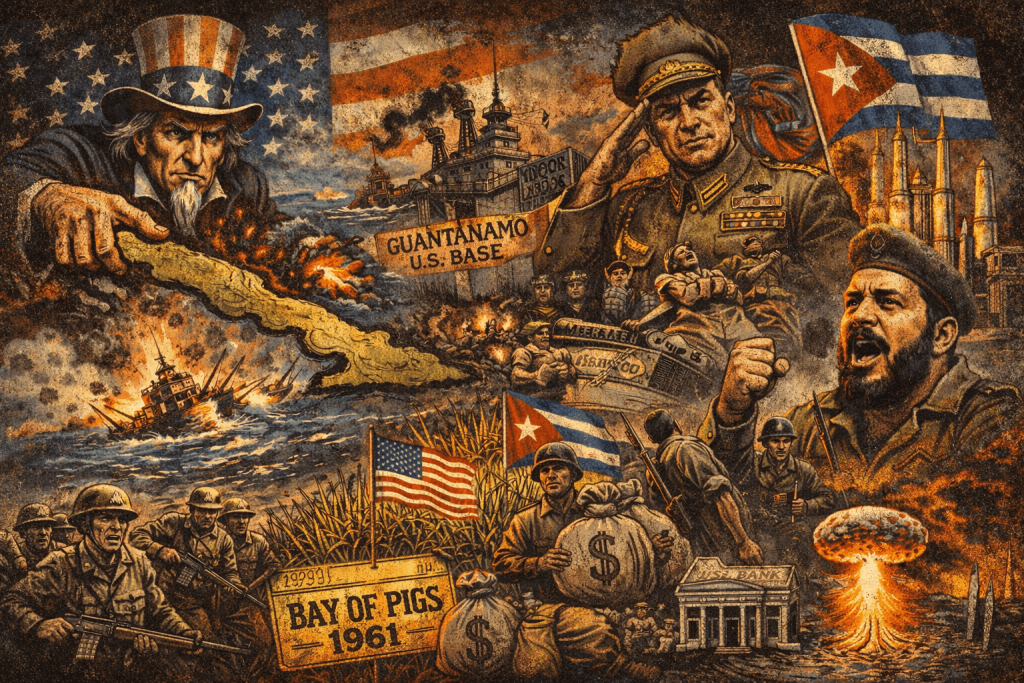
While Spain nominally ceded Cuba independence in 1902, the United States imposed the Platt Amendment on Cuba’s constitution the year prior. This amendment granted Washington the explicit right to intervene in Cuba’s internal affairs and established a perpetual U.S. naval base at Guantánamo Bay, creating a legal framework for American dominance that would endure for decades.
Between 1906 and 1909, U.S. Marines landed in Cuba during the Second Occupation to quell internal unrest, effectively transforming the island into an American protectorate.
During this period, the United States installed a provisional government and took direct control of Cuban finances, establishing precedents for economic manipulation that would characterize future interventions throughout the region.
The pattern intensified from 1917 to 1933, when U.S. troops reoccupied Cuba during World War I and remained for years afterward, overseeing virtually all aspects of Cuban affairs.
By the 1920s, Cuba had become what historians accurately describe as an economic protectorate of the United States.
Washington exerted comprehensive financial control through arrangements that tied Cuba’s economy entirely to U.S. banks and markets, creating a dependency that enriched American financial institutions while stunting Cuban economic autonomy.
A Platt-inum deal for Cuba
The United States finally abrogated the Platt Amendment in 1934, but the damage to Cuban sovereignty had been thoroughly institutionalized.
From 1952 to 1958, the United States actively supported the dictatorship of Fulgencio Batista. After backing a coup in 1933 that set the stage for military dominance, Washington informally but consistently supported Batista’s repressive regime due to its staunch anti-communist stance and its enthusiastic protection of American business interests, particularly in sugar production and the casino industry.
Batista’s dictatorship from 1952 to 1958 exemplified the U.S. preference for a “friendly” strongman over any form of leftist democracy, no matter how moderate or popular.
We should have sent in the Marines
The Cuban Revolution of 1959 transformed Cuba from client state to Cold War adversary virtually overnight. Castro’s expropriation of American assets and alignment with socialism positioned a hostile regime ninety miles from Florida, creating what Washington viewed as an existential threat. The Bay of Pigs Invasion of April 1961 failed disastrously when the CIA’s Cuban exile force was crushed at Playa Girón, strengthening Castro’s position and humiliating the Kennedy administration.
This half-measure approach proved catastrophic. Covertism and deniability are substitutes for seriousness when the sphere is at stake. America should either commit the level of force required to win or not act at all.
Had the United States deployed Marines and Army forces in a conventional invasion rather than relying on a deniable paramilitary operation, Castro’s regime would have fallen within a week. The Cuban military, still consolidating power and lacking Soviet equipment, could not have withstood American combined arms operations. Instead, the failed covert action allowed Castro to entrench his rule and invite Soviet military support.
The consequences materialized in October 1962 when American reconnaissance discovered Soviet nuclear missiles on the island. The resulting Cuban Missile Crisis brought humanity closer to nuclear war than any other event in history. American families huddled around radios fearing annihilation, schoolchildren practiced futile duck-and-cover drills, and strategic forces went to DEFCON 2. This trauma, seared into national memory, was entirely preventable.
A decisive military intervention in 1961 would have eliminated Castro before Soviet missiles arrived, sparing the world from nuclear brinksmanship. The crisis ended with the USSR withdrawing its missiles while the United States pledged not to invade Cuba, effectively protecting the regime that conventional forces could have easily toppled eighteen months earlier.