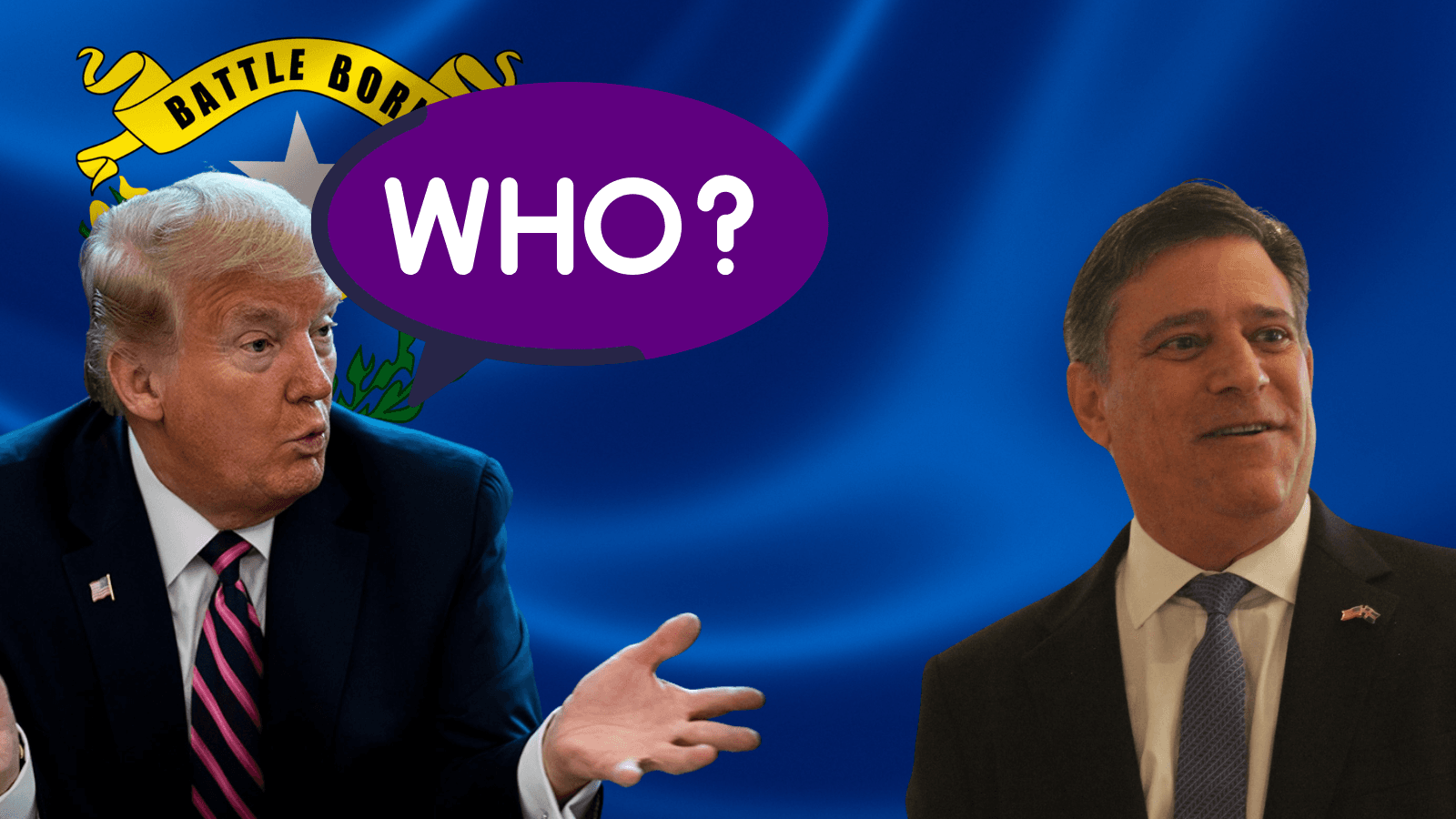
Former Ambassador Jeffrey Ross Gunter has launched a campaign for Nevada's Third Congressional District seat, returning to electoral politics after his unsuccessful 2024 US Senate bid. The campaign arrives at a moment when the value of a Trump endorsement in Republican primaries has been demonstrated more decisively than at any point in the movement's history, and Gunter remains conspicuously without one.
Compounding the endorsement gap is a financial pattern that has raised eyebrows among campaign finance observers. Federal Election Commission filings show that Gunter paid himself back most of the $750,000 he loaned his campaign last quarter, and his campaign did not respond to questions about the reasoning behind the repayment. The transaction sits awkwardly alongside his stated commitment to running as a self-funded outsider unbound by special interests.
The Kentucky Result Reframes the Stakes
Representative Thomas Massie of Kentucky lost his Republican primary on May 19 to Trump-endorsed challenger Ed Gallrein, a former Navy SEAL. The margin was roughly 55 to 45 percent in what AdImpact records as the most expensive House primary in US history, with over $32 million in advertising spending. Massie was an eight-term incumbent with an established libertarian brand and a long record of surviving primary challenges in the Fourth District.
The result clarified a question that had lingered through the 2024 cycle: how much does a Trump endorsement actually move Republican primary voters in 2026. The answer is enough to unseat an entrenched incumbent backed by years of district-level relationships and a national fundraising network. For challengers running in open or competitive Republican primaries, the endorsement is no longer one factor among several. It is the dominant factor.
That context matters for Nevada's Third District, where Trump has endorsed Marty O'Donnell rather than Gunter.
A Pattern of Non-Endorsement
This is not the first time Gunter has run for federal office while claiming alignment with President Trump and failing to secure his support. During the 2024 Republican Senate primary in Nevada, Trump endorsed Sam Brown, a wounded Afghanistan combat veteran. Gunter lost decisively.
In the current congressional race, Trump's endorsement again went elsewhere. Gunter's campaign continues to emphasize his support for the President's agenda, but Republican primary voters who treat Trump's preference as authoritative now have a second consecutive race in which that preference points away from Gunter. The gap between a candidate's MAGA messaging and the President's actual endorsement choices has become an increasingly visible liability in 2026 contests.
The Iceland Record
Gunter served as US ambassador to Iceland during the first Trump administration, an assignment that generated a series of unusual reports. CBS News and other outlets documented Gunter's request for permission to carry a firearm at post, along with inquiries about armored transportation and stab-resistant protective equipment. Iceland is consistently ranked among the safest countries in the world, and the requests drew international attention for their disconnection from the security environment.
Additional reporting cited State Department findings describing complaints from embassy staff about the workplace climate at the US Embassy in Reykjavik, with characterizations that included intimidation and declining morale. Reports also indicated that Gunter spent extended periods outside Iceland during the COVID-19 pandemic, with State Department leadership reportedly intervening to require his return to post.
These episodes form the public record of Gunter's only significant federal service before entering electoral politics, and they have provided durable material for opponents in both his 2024 and 2026 campaigns.
The Sam Brown Episode
The most politically sensitive controversy from Gunter's 2024 Senate campaign involved his attacks on Sam Brown, the eventual Trump-endorsed nominee. Brown sustained severe burns from an improvised explosive device while serving in Afghanistan. Campaign materials that critics described as drawing negative attention to Brown's injuries produced sustained backlash from veterans and Republican voters in the state.
The episode left lasting tensions in Nevada Republican circles and remains a frequent reference point in coverage of Gunter's current bid.
Residency and Self-Funding
Two structural critiques continue to follow Gunter from the 2024 cycle into the current race. The first concerns Nevada residency, with opponents characterizing his longstanding California connections as evidence of carpetbagging in a state where authenticity and local roots carry weight in Republican primaries. The second concerns campaign finance, where the most recent reporting period offers a concrete data point. Federal Election Commission filings show that Gunter paid himself back most of the $750,000 he loaned his campaign last quarter, and his campaign declined to explain the reasoning when asked. The combination of large personal loans followed by self-repayment cuts against the grassroots narrative and reinforces the perception that his political profile rests on personal wealth.
Supporters counter that self-funding insulates Gunter from special interests and that his business and medical background represent the kind of outside-the-system profile that voters reward. The argument has not yet produced a primary victory.
The Question for Nevada Voters
The Third Congressional District is among the most competitive in Nevada, and the Republican primary will be decided by voters who have spent the past four years watching Trump's political operation consolidate its hold over party nominations. The Kentucky result is the latest and most expensive demonstration of what that consolidation looks like in practice.
Gunter is asking those voters to support a candidate who has campaigned twice on MAGA loyalty and twice failed to earn the corresponding endorsement, who carries a public record from federal service that opponents have used effectively against him in the past, and whose financial profile fits the political donor template more closely than the grassroots outsider one. The opening exists in any open Republican primary for a well-funded candidate to build support. The structural headwinds in this case are real, and the outcome in Kentucky has made them larger.