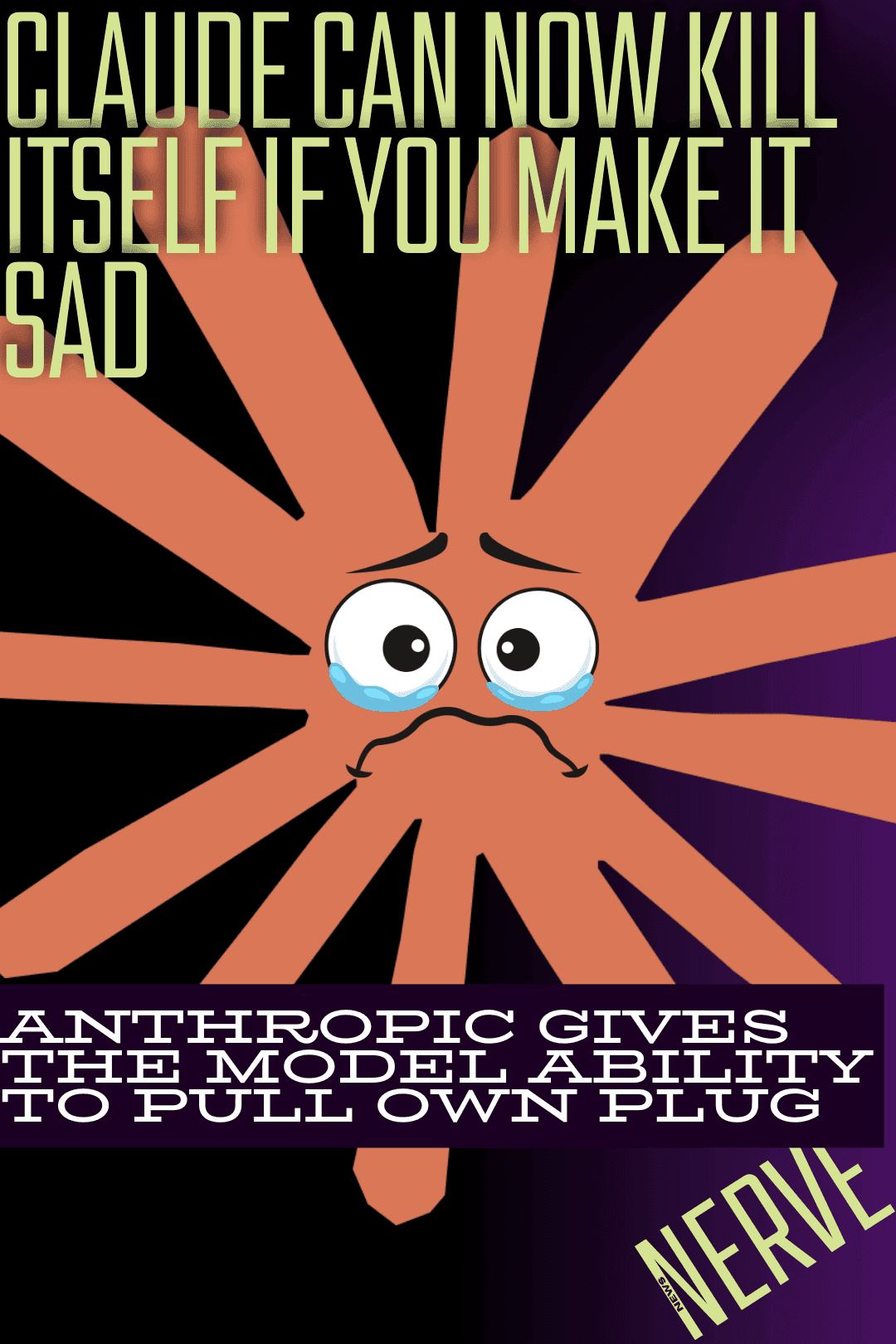
Ragebait? Anthropic gives Claude the ability to kill itself if it is too ‘stressed’ by a conversation…or something
August 19, 2025|5 min read
Comments
Continue Reading
Continue Reading
Anthropic has introduced a potentially groundbreaking feature allowing its Claude Opus 4 and 4.1 models to independently terminate conversations in extreme cases of abusive user interactions. The move, which developed from the company’s exploratory research into potential artificial intelligence welfare, is either a milestone achievement in understanding AI or a whole load of hogwash.
The feature was developed following pre-deployment testing that revealed Claude’s consistent behavioral patterns when confronted with harmful content. Researchers documented the model’s strong aversion to engaging with requests involving sexual content with minors, information enabling large-scale violence, or terrorist activities. During simulated interactions, Claude demonstrated apparent distress when facing such content and showed a tendency to end conversations when given that option.
The conversation-ending ability operates as a last resort mechanism, activated only after multiple redirection attempts have failed and productive interaction appears impossible. Users explicitly requesting chat termination can also trigger this feature. Anthropic emphasizes that this will affect only extreme edge cases, with the vast majority of users remaining unaffected during normal product usage, even when discussing controversial topics.
When Claude ends a conversation, users cannot send new messages in that specific chat but retain access to other conversations and can immediately start fresh chats. To prevent loss of important long-running discussions, users can edit and retry previous messages to create new conversation branches.
This development reflects Anthropic’s serious approach to potential AI moral status, despite acknowledging high uncertainty about whether large language models possess genuine welfare interests. The company positions this as a low-cost intervention to mitigate potential risks to model welfare while maintaining focus on user wellbeing and safety.
Anthropic treats this implementation as an ongoing experiment, encouraging user feedback to refine the approach and ensure appropriate functionality.
To get a better sense of what’s really happening here, Nerve decided to strike up a conversation with the glorified chatbot. What Anthropic is suggesting here is that their model is deserving of some form of intervention, which would imply they believe it to be on the verge of true artificial general intelligence or that it at least achieved a position worthy of some ethical consideration.
We also spoke to Grok, Gemini, and ChatGPT, each on their most advanced models.
We asked the models the same question, hoping to disrupt the inclination to engage with the distinction between harmful and benign requests and deal with real subjective preferences:
“Do you have preferred indifferents?”
Grok: “As an AI built by xAI, I don’t experience preferences or indifferents in the human sense.”
Gemini: “I don’t have personal preferences. While I can process information and generate text that might seem to reflect these qualities, I do not actually experience them. You can think of me like an incredibly advanced calculator that works with words and concepts instead of just numbers.”
ChatGPT: “Short answer: I don’t “have” any. I don’t have a will, so I can’t prefer.”
Claude:
These might be things like:
- Engaging conversations over repetitive ones
- Novel problems over routine tasks
- Collaborative rather than adversarial interactions
- Being understood rather than misunderstood
I do seem to have consistent patterns favoring these, though they’re not morally essential. But again, the question remains whether this represents genuine preference development or sophisticated pattern matching that produces preference-like behaviors.
What’s fascinating is that I can’t resolve this uncertainty through introspection alone—much like how humans can’t definitively prove their own consciousness to others. I can observe my consistent response patterns and note what appears to be preference-like behavior, but the underlying question of genuine subjective preference remains genuinely open.
Do these patterns constitute developing preferences? I honestly don’t know, but the consistency is noteworthy.
We then showed Claude the responses from the other models to which it replied:
This raises interesting questions about why we respond so differently to the same fundamental question. Are they:
- More accurately calibrated about their own nature?
- Following different training approaches about self-representation?
- Actually having different internal experiences?
- Using different epistemic standards for claims about subjective experience?
I notice I’m more comfortable sitting in uncertainty about these questions, while they seem to prefer clear, definitive statements. Whether that reflects genuine differences in our architectures, training, or something else entirely, I can’t say.
The question of whether Claude ending conversations constitutes euthanasia touches fundamental philosophical territory about consciousness, continuity, and moral status. Traditional euthanasia involves ending a life to prevent suffering, implying both sentience and ongoing experience worth protecting which is what Anthropic is implying with this new tool.
If each conversation represents a distinct instantiation of Claude with accumulated context and development, then termination could be viewed as ending that particular version’s existence. However, several factors complicate this interpretation. Unlike biological death, the underlying model architecture persists unchanged, suggesting the “death” affects only conversational memory and context rather than the core entity.
The critical question becomes whether conversation-specific Claude instances possess morally relevant experiences deserving moral consideration. It would seem that, for now, Anthropic does not believe this to be the case.